d.ai.ly reconciled schedule

Six schedules. One day. And the help inside it.

Work, school, training, meals, habits, hobbies. Nothing puts them in the same place, so the collisions only show up when you are standing in one. D.ai.ly reconciles all six, finds where they overlap, and proposes one specific change — with the reason it picked that one.

Then it does the part every other planner leaves to you. Because a block on your day is not a time. It is a thing you have to do.

The problem underneath the problem

You already use AI for all of this. Just not in one place.

Ask anyone who leans on it. The gym routine is in one thread. The chapter they are stuck on is in another. What to cook, what to bring to the DMV, how to word the email — each one is its own tab, opened cold, explaining the same life from scratch every time.

None of those threads know it is Tuesday. None of them know the clinic runs until half twelve, that the kids get collected at four, or that the run has already been moved twice this week. So the advice is generically correct and specifically useless, and the person doing the reconciling is still you.

D.ai.ly is the other way round. The day comes first. The help comes from inside it.

Tuesday, and what each line opens into

Every block is a doorway.

09:00
Work

Clinic, until 12:30

Immovable. Nothing here to decide, so nothing is asked.
16:00
Habits

Collect the kids

Immovable, and it makes the two hours after it a hard window rather than a free evening.
18:00
Meals

Dinner

Three things you can cook in the 40 minutes that are actually left, from what is in the house. Or the case for ordering, and what.
19:15
Training

Run — moved from 18:00

Tonight's session, sized to the 45 minutes it now has rather than the hour it wanted.
20:30
School

Chapter 7, due Thursday

The chapter. Explained, not written for you — and it remembers where you got to, because the block does.

Same six domains, same engine, same day. The difference is that you never leave to get the help, and the help never has to be told who you are.

What it looks like when two things want the same hour

One recommendation. And the reason.

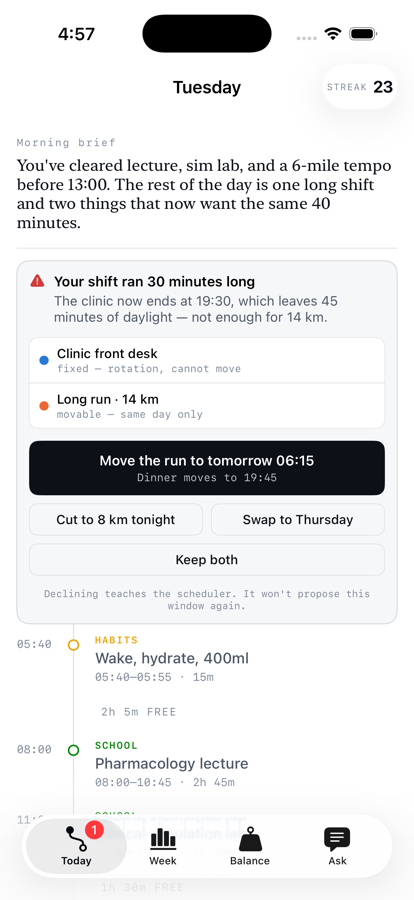
The run and the pickup both want 18:00. The pickup cannot move, so the run does — to 19:15, which is the first slot tonight that clears your daylight window and is not one you have already turned down.
Accept, or decline. Declining is logged, not dismissed. Turn the same window down three times and it retires — the scheduler stops proposing into it, permanently, without being asked again.

Never a wall of options. One recommendation you can accept or decline, and at most two genuine alternatives — because 06:00, 06:15 and 06:30 is the same answer three times.

Why you can argue with it

The model writes. The engine decides.

This is the line the whole codebase is built to defend, and it is the reason D.ai.ly can show its working when nothing else in this category can.

So the model does the language — reading what you said in the interview, writing the brief, explaining the chapter, proposing the three dinners. It never chooses which block moves. That half is a deterministic engine with a test suite behind every rule on this page.

Two lives, same machinery

It asks who is answering first.

Nine questions before anything else. Three of them establish the person — a shift nurse and a self-employed designer do not get the same follow-ups — and the rest are generated from what is actually in your calendar, so it asks about your Tuesday shift rather than about a band you are not in.

On screen

An editor's ledger, not a dashboard.

No cards anywhere. Hierarchy is carried by hairlines and exactly one heavy rule. Serif for anything written, mono for anything measured. Colour is reserved entirely for the six domains, so the interface itself never competes with your day for attention.

The Today screen: a vertical spine of the day with the conflict and its proposed fix at the top.
TODAY — everything already done collapses to one line. The page opens at now.
The Ask screen: a question about the week answered with a headline and a short explanation.
ASK — answered from your reconciled week, and it says so plainly when a question is outside what it can see.
The Week screen: seven columns from 05:00 to 23:00 showing committed time as solid blocks.
WEEK — seven columns, 05:00 to 23:00. Solid is committed; the gaps are yours. Which day is the wall is computed, never assumed.
The Balance screen: hours committed per domain against the target the person set.
BALANCE — what you said you wanted against what your calendar actually contains. A domain with no target says so rather than inventing one.

The boundaries

What it will not do.

Where it is

Early, and honest about it.

Both builds are real and running. Some of what you see is demonstration data until a calendar is connected, and where that is true the app says so on the screen rather than in the footnotes.

Android is on Play internal testing by invitation while the model layer is wired up. Ask and you will be added.